Case Study

Learn how Humble Good helped MINNeSTAY transition to our AI-ready platform.
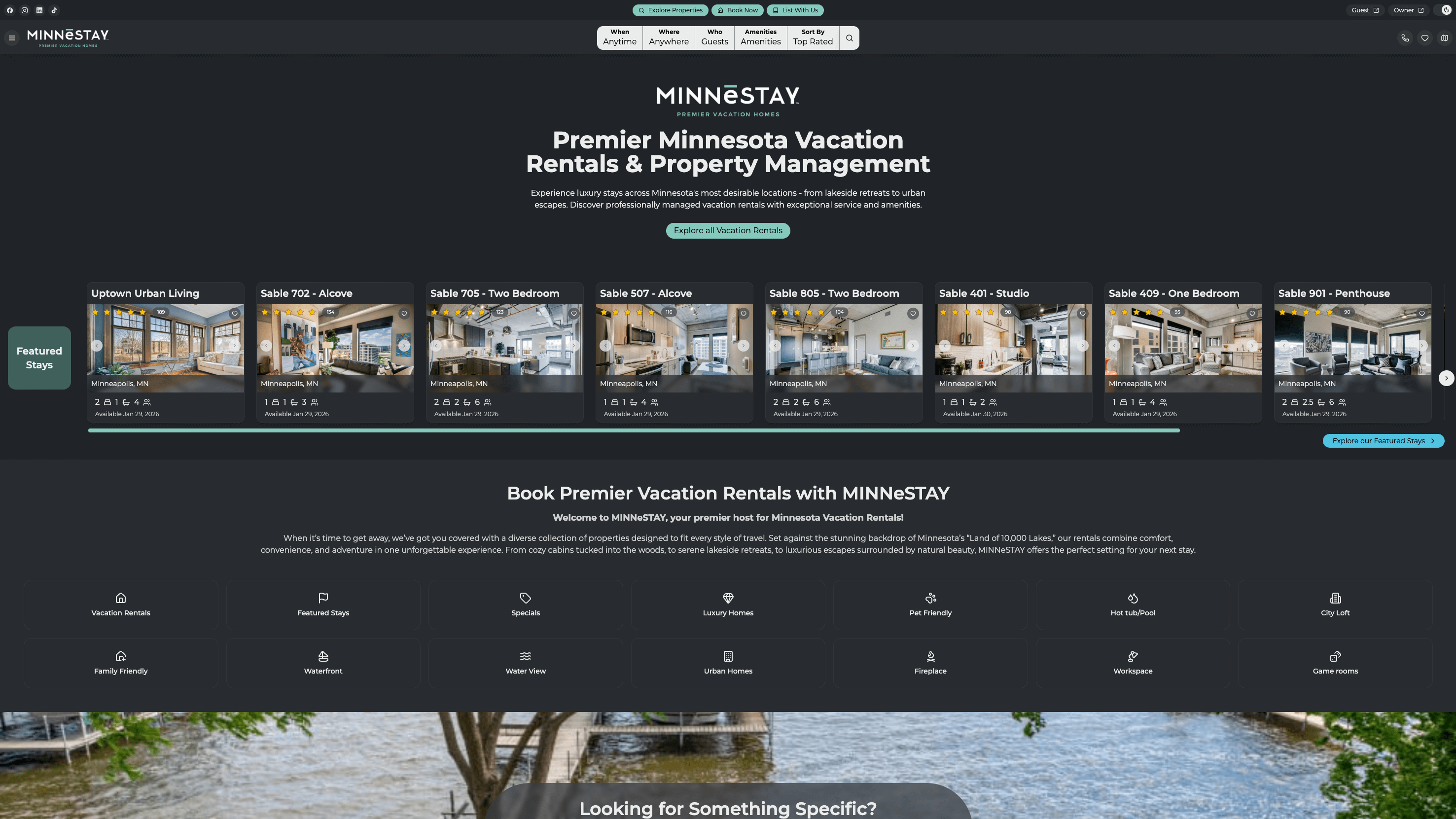
MINNeSTAY Homepage

MINNeSTAY

Premier Minnesota Vacation Rentals

How one Minnesota vacation rental company rebuilt its digital presence to serve both human guests and the AI systems increasingly guiding them — and uncovered a new model for brand intelligence along the way.

The Challenge.

MINNeSTAY manages a portfolio of vacation rental properties across Minnesota and western Wisconsin. Their site provided limited control over the booking experience, with very limited ability to curate or personalize content, and no visibility into how guests were actually engaging with the site.

Meanwhile, the rise of AI-powered search and chat tools — ChatGPT, Google Gemini, Perplexity meant a growing share of potential guests would never visit a traditional website at all. And when MINNeSTAY tested what these AI systems knew about their brand, the result was minimal. . AI is incredibly broadly intelligent, but it lacked the specifics needed to represent any individual brand with depth or accuracy.

The question wasn't just "how do we modernize our site?" It was "how do we build a digital presence that works for the customers we can see *and* the AI systems we can't — while giving both audiences something genuinely informed about who we are?"

"We partnered with Humble Good because we needed more control: a booking experience we could actually manage, clearer marketing levers, and better ways to surface the right content to the right guest. The new MINNeSTAY site delivers on all of that, especially with image sorting that helps guests quickly see what matters most, and it's set up to evolve with AI enhancements in guest Q&A and search."

Lance B.

MINNeSTAY

The Approach.

This started with a conversation about how AI is going to change everything. MINNeSTAY and Humble Good shared that conviction, but neither knew exactly what it would look like in practice. Rather than wait for clarity, they decided to explore — starting with proofs of concept around integrating large language models into a live web experience.

The early explorations revealed a foundational problem: AI tools could answer broad travel questions, but the moment you asked them to represent a specific brand — its properties, its personality, its value proposition — the responses became generic at best, inaccurate at worst. The AI had breadth but no depth about *their* business.

That realization led to a core architectural decision. To get past the trivial nature of AI conversations about a brand, the platform would need to manage the brand's intelligence — not just its content. True intelligence requires two things working in concert: a deep context of what you're offering (your content, your brand knowledge) and a clear understanding of how people interact with it (your analytics, your customer behavior). Content is what you know. Analytics is what your customers are telling you. Together, they create the foundation for genuine customer insight.

Three foundational ideas.

That insight shaped a platform built on three foundational pillars.

Dual Rendering: One Source, Two Audiences

All pages within the new MINNeSTAY site are rendered in two formats simultaneously. Visitors see a rich, interactive HTML experience. AI systems — chatbots, search engines, recommendation tools — get structured plain-text and markdown versions through a set of dedicated endpoints (/llms.txt, /llms-full.txt, /llms-units.md, and per-property markdown files). This isn't a bolted-on afterthought; it's the same source content, rendered natively for two different consumers.

As a result, AI assistant answers "Where can I find a pet-friendly cabin on a lake in Minnesota?", MINNeSTAY's properties can surface with accurate, structured, brand-authentic detail — not scraped snippets or hallucinated facts. The brand's intelligence is accessible to every system that might represent it.

Analytics That See the Full Picture

The platform tracks visitor journeys from first touch through booking — sessions, page views, search behavior, and conversion events. But it extends that visibility beyond human traffic. When AI systems query the site's content endpoints, those interactions are surfaced alongside human analytics, giving MINNeSTAY a view into how all consumers of their content — human and machine — are engaging with their brand.

Conversion tracking bridges external AI-driven experiences with on-site bookings, so MINNeSTAY can trace a reservation back to whether the guest found them through a traditional search engine, a direct visit, or an AI chat tool. Every touch-point feeds the intelligence layer.

Semantic Recall: From Image Search to AI Agent

The platform introduces a semantic layer that understands content by meaning, not just metadata. It started with image recall — AI embeddings applied to every property photo so that when a guest searches for "fireplace" or "dock," images matching that concept rise to the top across the entire portfolio. As Lance highlighted, this helps guests quickly see what matters most without scrolling through dozens of generic photos.

That foundation is evolving into full natural language search, where semantic understanding works alongside traditional data filters — guests can ask for a "cozy winter getaway with a hot tub" and the platform blends intent-based matching with concrete criteria like dates, location, and availability. The trajectory leads to a deeply integrated AI agent: a system that doesn't just search but understands the guest's needs in context, recalls the right content from across the brand's knowledge base, and guides them toward the best match — all within a seamless, branded experience.

"Overall, it's a great platform to send paid traffic to — super interactive and engaging in a way that will give us great insight into user activity on the site. The ability to curate based on time of year or user is fantastic — Google will likely give us some bonus points since our landing pages will be aligned with the user's search intent."

Josue G.

Account Manager, Star Tribune Digital Marketing

What's Next?

What started as a website rebuild has grown into a marketing enablement platform — and the roadmap goes further still.

Conversational Web Experiences.

The new MINNeSTAY site is not an AI-powered Q&A bolt-on. It's a fundamentally new interaction model: natural language conversations with dynamically rendered, branded content fully integrated into the dialogue. A guest asks about lakefront properties that allow dogs, and the response isn't a text block — it's a curated, visually rich, interactive experience rendered in real time within the conversation itself.

Critically, this comes with guardrails. The intelligence management layer ensures that every AI-generated response stays on brand and accurate to the business being represented. The AI doesn't freelance — it draws from the brand's managed content and knowledge base, so the conversation is always grounded in truth.


Customer Understanding Engine.

The analytics layer will deepen into a true customer understanding engine. Analysis of each user journey — what they searched for, what they lingered on, what they booked, what they abandoned — builds toward two levels of insight. At one end, a personalized understanding of each individual customer. At the other, a clear picture of the real customer personas the brand serves — not theoretical marketing personas, but data-derived profiles of who actually shows up and what they want.

These insights will flow directly to business operators, informing everything from content strategy to pricing to property acquisition decisions. The intelligence layer doesn't just fuel the AI — it fuels the humans running the business.


Adaptive Optimization: A Self-Learning Platform

Traditional website optimization is manual: someone designs an A/B test, waits for statistical significance, picks a winner, repeats. That model doesn't scale in an environment where content, audiences, and channels are all shifting simultaneously.

The platform is being architected to learn continuously. Every customer interaction — searches, page views, booking behavior, abandonment patterns. These feed the intelligence layer, which identifies what's working, for whom, and why. Over time, the platform adapts: surfacing content that resonates with specific customer segments, adjusting messaging to align with demonstrated intent, and optimizing conversion paths based on observed behavior rather than guesswork.

This isn't optimization through periodic experiments. It's a closed loop — content drives interactions, interactions produce insight, insight refines content — that gets smarter with every guest who engages with the brand.


Conversational Web Experiences

The platform will continue building revenue levers directly into the guest experience. Including tiered rate options at checkout, short-term rental equivalent of airline fare classes , and providing guests meaningful choice while creating natural upsell pathways. Add-on experiences and convenience packages increase average booking value. Intelligent conversion recovery and return guest engagement, both powered by the customer understanding engine, turn abandoned bookings into completed reservations and one-time guests into repeat customers.

The common thread: every revenue lever is informed by the intelligence layer. Recommendations are relevant because they're based on what the guest actually searched for and how they behaved. Offers are personalized because the platform understands the customer, not just the transaction.


Conversational Web Experiences

At the end of the day, websites are about connecting with your customers. They are a marketing tool — a way to inform, engage, and convert. But the landscape of how that connection happens is changing faster than any single-channel strategy can keep up with.

Humble Good's Conversated platform is on a path to become the intelligence layer that fuels a brand's ability to transact business in this shifting environment. Content and analytics working together. Human and AI audiences served equally. Customer understanding that gets sharper with every interaction. All of it aimed at a simple outcome: a better connection with the customer, and in turn, greater business success.

Join the Founding Member Program.

MINNeSTAY was our first. We're now looking for a small number of forward-thinking property management companies to join our Founding Client Program — an opportunity to get on the platform early and help shape where it goes next.

  • Direct input into the platform's roadmap
  • Priority access to new capabilities as they come online
  • Build your intelligence layer now — while competitors are still debating whether AI matters

Spots are limited by design. We work closely with each founding client to ensure the platform evolves in ways that drive real results.

MINNeSTAY is a property management company serving Minnesota and western Wisconsin. Learn more at MINNeSTAY.com